Brotato: Premium
- 4.8
- Rating
- 1.00M
- Installs
- $4.99
- Price

 Analysis by App-foxy
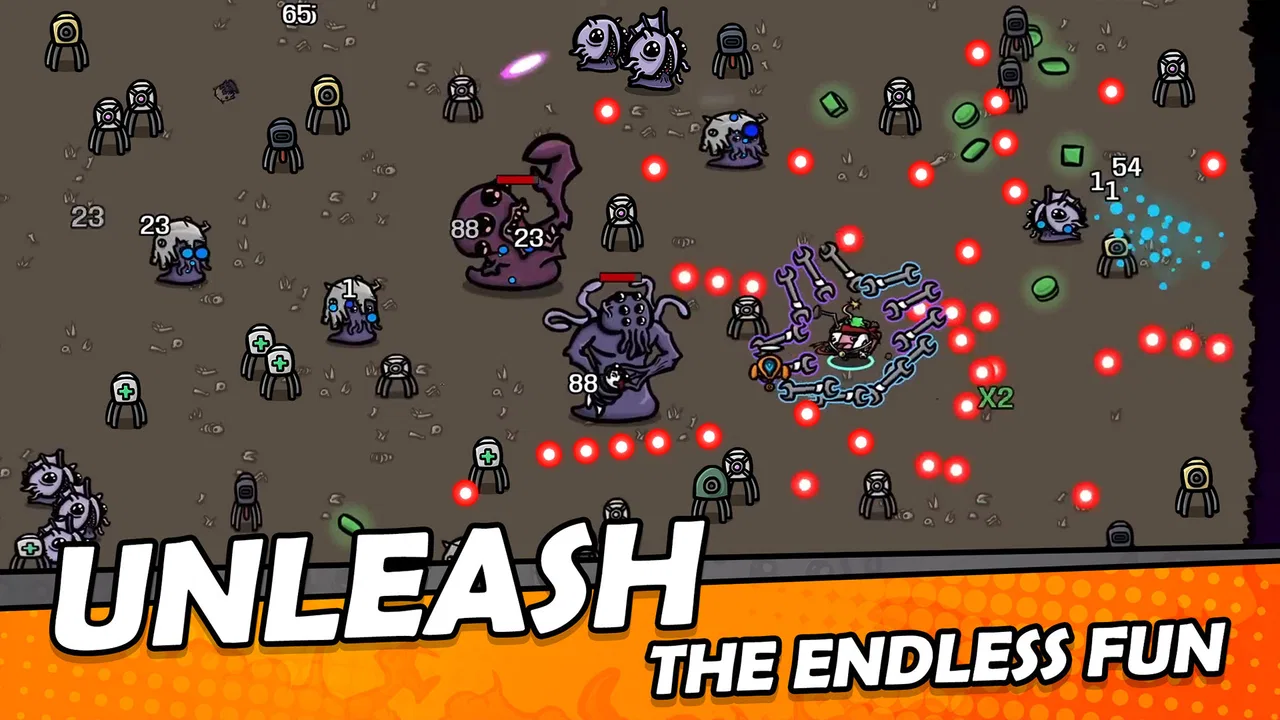
I went into Brotato: Premium expecting a quick action game built around surviving crowded encounters, and that is exactly where it works best. It puts you in control of a potato-shaped fighter facing alien attackers, with the unusual advantage of carrying several weapons at once. The result is fast, messy, and surprisingly thoughtful: I can spend a run reacting to danger, then spend the next one thinking carefully about how to make a build that handles the next wave better.
This is a paid action game from Erabit Studios, available for Android and iOS, and it fits people who enjoy short roguelite sessions rather than a long story campaign. Its store average is 4.8 from around 59 thousand ratings, and it has passed one million installs. Those figures suggest a broad audience, but they do not remove the need to understand its rhythm. The game is intentionally repetitive: you fight, improve your setup, get overwhelmed or succeed, and start again with a better idea.
Why the first few runs are more interesting than they look
The opening goal is simple enough to understand immediately: stay alive while alien enemies close in. That clarity matters on a phone because I do not need to learn a complicated plot, a large map, or a long list of controls before having fun. The action starts quickly, and the main question is always practical: can my current equipment deal with what is approaching?
You May Also Like

 Blood Strike: 2.5 Anniversary
Blood Strike’s Loadouts Turn Every Drop Into a Tactical Gamble
A close look at Blood Strike’s custom loadouts: how fast access to signature weapons reshapes its battle royale rhythm, rewards preparation, and narrows the gap between fights.

 Pandora - Music & Podcasts
Pandora’s Music Is Easy to Start, but Harder to Recover
Pandora’s strength is its low-effort path from a seed to a station. Its weak spot is how much confidence it asks you to place in connection, setup, and quiet recovery.

 8 Ball Pool
 Is Built on Rivalries, Rematches, and Routine
A close look at the rivalries, rematches, shared routines, and unanswered safety questions that turn a quick pool match into a persistent mobile community.

 Samsung Music
’s Quiet Strength Is Playing What You Already Own
Its reach comes less from spectacle than from dependable access to a personal library. That simplicity is both the app’s strongest retention engine and its ceiling.

 AccuWeather: Weather Radar
AccuWeather Review: A Quick, Clear Forecast for Everyday Decisions
For everyday plans, the best forecast is the one you can understand quickly. AccuWeather makes rain timing, radar, and local conditions easy to act on, with a few trade-offs.

 Hill Climb Racing
Why Hill Climb Racing Still Turns Crashes Into One More Run
A tiny car, a bumpy hill and one more upgrade: Hill Climb Racing keeps resurfacing because its simple chaos makes every near-miss feel personal.
More From Our News Desk



The six-weapon limit gives the early game its first meaningful decision. I am not merely collecting one stronger item and watching the numbers rise. I have to think about how the whole loadout behaves when enemies surround me. A weapon that feels excellent in an open space may be less useful when movement becomes restricted, while a less impressive choice can become valuable if it helps cover a weakness in the rest of the setup.
That makes the first few attempts useful even when they end badly. I learn which attacks let me keep moving, which combinations leave gaps, and how quickly a comfortable situation can turn into a scramble. The game does not need a large tutorial to communicate this. The pressure teaches me through direct consequences, although players who prefer a relaxed introduction may find the pace abrupt.
One of my favorite early habits is to treat each run as a test rather than a final exam. If I choose a weapon because it looks powerful, I pay attention to the situations where it fails instead of immediately blaming the game. If I focus too heavily on one kind of damage or one style of attack, the next encounter exposes that choice. This makes experimentation more useful than blindly chasing the biggest-looking upgrade.
Six weapons create a real build problem
Carrying six weapons at once sounds like pure power, but it also creates clutter in decision-making. Every slot represents an opportunity cost. Keeping a familiar weapon may make the current run safer, yet replacing it could produce a more balanced setup. I found that the best choices were not always the most exciting ones; sometimes the sensible option was the one that made the entire group of weapons behave more consistently.
This is also where the game separates itself from a basic arena shooter. In a simpler alternative, I might focus on aiming and firing until the screen is clear. Here, the loadout can decide whether I have a chance before the most dangerous part of a run begins. The action remains accessible, but the equipment decisions give it a layer of planning that rewards replaying the same general challenge with a different approach.
A useful tip is to judge a weapon by the space it creates, not only by how quickly it defeats one target. When enemies arrive from several directions, survival depends on keeping an escape route open. I started valuing choices that helped me control the edges of a crowd, because a strong attack that leaves me boxed in can be worse than a modest one that lets me reposition.
Progress feels visible when a failed run teaches something
The strongest progress signal is not simply reaching a later point. It is recognizing why a previous attempt failed and seeing a practical way to correct it. After a few runs, I began noticing patterns in my own decisions: I would hold on to a comfortable weapon for too long, move toward rewards without considering the surrounding enemies, or assume that a strong early setup would remain strong under heavier pressure.
That learning loop gives the game a satisfying sense of forward motion even when a run ends. A new attempt feels different because I am making better choices, not because the game is constantly interrupting me with explanations. The improvement is personal and immediate. I can tell when I am surviving because I adapted rather than because I simply got lucky.
The challenge also encourages small goals. Instead of thinking only about complete victory, I can aim to last longer, make a more coherent six-weapon arrangement, or avoid repeating the mistake that ended the previous run. These goals are especially useful on a phone, where I may only have time for one focused session. The game gives that short session a clear purpose without requiring me to remember a complicated narrative objective.
There is a trade-off here. Players who need a strong story, character relationships, or a detailed world may find the progress too abstract. The satisfaction comes from builds, survival, and personal improvement. If those elements do not interest you, the repeated structure may feel like doing the same task again rather than developing toward something meaningful.
The difficulty curve rewards attention, not panic
The difficulty works because it changes the value of my decisions as a run continues. A setup that handles the beginning can become unreliable once enemies fill more of the available space. I cannot assume that a comfortable opening means the rest will take care of itself. The pressure gradually turns movement, positioning, and equipment choices into connected problems.
I found that panic was usually more dangerous than the enemies themselves. When I rushed toward a tempting pickup or changed direction too sharply, I often created the collision I was trying to avoid. Calm movement became a skill. I learned to look for a route before the crowd closed in, rather than waiting until there was only one desperate escape.
This is one of the game’s less obvious strengths: it makes positioning feel like part of the build. A weapon arrangement may be effective only if I can keep enemies at a useful distance, while another setup may tolerate closer contact but require more careful movement. The same collection of weapons can therefore feel different depending on how confidently I navigate the arena.
My practical advice is to avoid making every decision during the most crowded moments. When the game gives me a chance to evaluate equipment or prepare for what comes next, I try to decide with a specific weakness in mind. Am I struggling to clear enemies, losing too much space, or failing because my setup is too dependent on one attack? Naming the problem prevents random upgrades from turning into a messy build.
The curve is not ideal for everyone. Someone looking for a gentle casual game may be frustrated by runs that collapse after a promising start. Conversely, experienced action players may appreciate that the game does not let early success guarantee a comfortable finish. Its appeal depends on enjoying pressure that exposes poor preparation.
Short sessions fit everyday play, with a catch
I can imagine playing this while waiting for an appointment or taking a short break, because the core loop is easy to resume mentally. I do not need to remember a long quest chain. I only need to remember what kind of build I want to try and what mistake I am trying to avoid. That makes it more convenient than many larger action games that demand a longer uninterrupted session.
A realistic example is a commute where I have enough time for one attempt but not enough patience for a story-heavy game. I can start with a clear objective, test a weapon combination, and stop after the run without feeling that I abandoned a conversation or missed a crucial plot detail. The game is also suitable for a player who likes discussing strategies with friends, because the six-weapon limit gives every run an understandable point of comparison.
There is still a retention pressure built into the structure. The desire to try one more run comes from knowing that a small change might solve the last failure. That can be motivating, but it can also become tiring if every attempt starts to feel like a near miss without a satisfying sense of discovery. I recommend taking a break when I notice that I am repeating the same build and expecting a different result. The game rewards changing my approach more than grinding through frustration.
The paid price is $4.99, with optional in-app purchases listed at $2.99 per item. For me, the upfront cost makes sense if I already know I enjoy roguelite action and repeated runs. It is less convincing for someone who wants a free, endlessly varied experience without any purchase decision. The age rating is Everyone 10+, which suits the cartoon presentation and straightforward combat, though younger players may still need help understanding why a failed run is part of the design rather than a conventional game-over screen.
Where it stands beside familiar action alternatives
Compared with a traditional twin-stick shooter, this game places more weight on preparation and less on precise manual aiming. The pleasure is not just in reacting quickly; it is in building a set of six weapons that can survive changing pressure. Compared with a story-led action game, it offers far less narrative context but gets to the playable decisions much faster.
It also differs from slower strategy roguelites. I still make meaningful choices, but I make them while thinking about immediate survival. There is not much room for leisurely planning once the alien crowd is close. That combination will suit players who want strategy to influence action without turning the game into a menu-driven planning exercise.
The best alternative depends on what I want from my phone. If I want a campaign with exploration and character development, I would choose something else. If I want a relaxed puzzle game, this is clearly the wrong direction. But if I want compact sessions where a weapon decision can change the entire feel of a run, Brotato occupies a useful middle ground between reflex-heavy shooting and build-focused replayability.
One point worth considering is input comfort. Fast movement and crowded encounters are central to the experience, so anyone who struggles with small-screen controls should try a short session before committing emotionally to the game. The action is readable, but readability does not automatically make intense moments easy. A larger display can make the pressure more manageable, while a cramped phone screen may make the same run feel unnecessarily chaotic.
Does the unlock-and-challenge loop hold up?
The long-term appeal depends on whether I enjoy turning failure into a new experiment. Goals remain engaging when they give me a reason to revisit the action with a different plan, and the game’s weapon limit naturally supports that kind of variation. I can focus on making a balanced setup, testing an aggressive idea, or learning how to survive when my preferred approach stops working.
The progress signals are strongest when they change my understanding of the game. Reaching a difficult point is satisfying, but understanding why I reached it is more valuable. I know I am improving when I stop treating every weapon as an isolated upgrade and start asking how the whole loadout supports movement, crowd control, and survival.
Its retention is therefore based more on mastery than on a promise of constant novelty. That is a strength for players who like refining decisions, but a limitation for people who need a large stream of new locations or story events. The game can keep me interested for a long time when I am curious about what another build can do. It is less likely to hold me if I see repetition as a flaw rather than as the foundation of the experience.
The current version is 1.3.492, and it supports devices running Android 6.0 or later. I would still check how comfortable the game feels on my own device before planning long sessions, especially if I prefer playing with one hand or on a smaller screen. The basic requirements are approachable, but the real question is whether the controls and visual pressure suit my personal setup.
My verdict after weighing the loop
I recommend Brotato: Premium to players who want a focused action roguelite with clear early goals, meaningful weapon choices, and a difficulty curve that rewards learning. Its strongest feature is the way six weapons turn a simple survival premise into a series of build problems. I am rarely asking only whether I can attack faster; I am asking whether my entire setup gives me enough options when the arena becomes crowded.
I would skip it if I need a story campaign, relaxed pacing, or a feeling of permanent progress after every session. The repeated runs can feel demanding, and the challenge may expose the same mistake several times before I understand how to correct it. The optional purchases also mean the price is not the only spending detail to consider, even though the game begins as a paid download.
For me, the progression works because it turns short attempts into useful information. I can finish a run with a better plan, not just a higher score, and that distinction keeps the action from becoming empty repetition. The game is at its best when I treat every run as a build experiment with a survival lesson attached.
Erabit Studios has made a compact mobile action game that respects quick sessions while still offering enough depth for careful players. It is not trying to replace a large console adventure, and it should not be judged by that standard. When I want immediate action, a reason to rethink my equipment, and a challenge that becomes clearer through practice, Brotato: Premium is an easy recommendation. When I want calm exploration or a narrative payoff, I reach for something else.
FAQs for Brotato: Premium
01What is Brotato: Premium?
Brotato: Premium is the paid mobile version of the popular top-down arena survival game. You play as a potato armed with multiple weapons and fight through increasingly difficult waves of aliens. Each run combines fast twin-stick shooting, character selection, random item choices, and build customization, making it easy to start but surprisingly deep when you begin experimenting with different strategies.
02Does Brotato: Premium include advertisements or in-app purchases?
One of the main advantages of Brotato: Premium is that it is designed as a premium purchase rather than a free-to-play experience. The game does not rely on forced advertising to interrupt your runs, and the core gameplay is available after purchase. Availability of optional content or platform-specific purchases may vary, so it is still worth checking the store listing on your Android or iOS device before downloading.
03Can Brotato: Premium be played offline?
Brotato: Premium is well suited to offline play, which makes it convenient for travel, commuting, or situations without a reliable internet connection. Most of the game’s central features, including starting runs, fighting enemies, collecting items, and progressing through difficulty levels, can be enjoyed without being connected. Internet access may still be required for downloading the game, updates, or certain device services.
04Is Brotato: Premium suitable for beginners?
Yes, although the game can become challenging quickly. The controls are straightforward, with movement and aiming designed for touchscreen play, while weapons often attack automatically or according to your chosen setup. Beginners can start with easier characters and difficulty settings, learn how item bonuses work, and gradually improve. Later runs demand more careful positioning, resource management, and thoughtful weapon combinations.
05What devices are needed to play Brotato: Premium smoothly?
Brotato: Premium generally runs well on modern Android phones, tablets, iPhones, and iPads because its visual style is simple and its technical requirements are modest compared with many action games. Performance can still depend on your device’s age, operating system, available storage, and background apps. Before downloading, check the official Google Play or App Store listing for the latest compatibility requirements.
Pros
- Fast
- satisfying runs that work well for short play sessions.
- Many weapons and builds create strong replay value.
- Offline play makes it convenient for travel or low-connectivity situations.
- Simple controls are easy to learn on a touchscreen.
- Premium version avoids forced ads and free-to-play energy limits.
Cons
- Difficulty can spike sharply
- especially on higher danger levels.
- Runs may feel repetitive once familiar builds become dominant.
- Small on-screen targets can be difficult to distinguish during hectic waves.
- Unlocking every character and item requires considerable time.
- Some devices may experience heat or battery drain during longer sessions.

Brotato: Premium
Gallery